




Micro Commercial Components (MCC) DC Fast Charging Solutions
MCC DC Fast Charging Solutions support the next generation of EV infrastructures with high-performance components designed for speed, safety, and system efficiency. As global EV adoption accelerates, fast chargers are crucial for meeting driver expectations, cutting charge times dramatically, and making electric mobility more practical and scalable.
DC fast charging has redefined the EV experience by delivering significantly faster charge times, often restoring 80% of battery capacity in just 20 to 30 minutes. Unlike conventional AC chargers, these systems bypass the onboard charger and feed high-voltage DC power directly into the vehicle battery. MCC enables this transition with discrete semiconductor components built to handle modern charging stations' high power, fast switching, and safety demands.
MCC helps enable the high-speed, high-efficiency backbone of EV charging infrastructures, empowering engineers to build reliable, standards-compliant fast charging stations that accelerate the global shift to electric mobility.
Design Requirements
- Design Priorities for Engineers - MCC components are engineered to support the demanding requirements of EV fast-charging systems
- Charging speed - Enable high transfer rates matched to battery capabilities
- High-voltage capability - Efficiently manage up to 800V for reduced losses and better thermal behavior
- Thermal and surge protection - Guard against overheating and voltage spikes in real-world conditions
- System efficiency - Reduce conduction and switching losses with low RDS(on) MOSFETs and fast diodes
- Cost efficiency - Provide competitive performance-to-cost ratios for scalable deployment
- Interoperability - Support compatibility across EV platforms and global connector standards
- Scalability - Adapt to commercial, passenger, and fleet charging applications
- Environmental robustness - Ensure long-term reliability in extreme climates and outdoor conditions
- Standards compliance - AEC-Q101 qualified parts help ensure system alignment with CCS, CHAdeMO, and regional safety protocols
- DC fast charging systems rely on two key power conversion stages, both requiring robust and efficient power components
- AC-to-DC conversion
- Grid-supplied three-phase AC is rectified into high-voltage DC, typically 800V, via a full-bridge Power Factor Correction (PFC) circuit for DC-DC conversion. A secondary converter adjusts voltage to suit the battery's specific requirements. Leading architectures include CLLC Converters (to reduce losses, use a resonant tank for the bidirectional, soft-switching operation) and Dual Active Bridge (DAB) Converters (feature symmetrical full bridges for isolated, high-frequency, and efficient energy transfer)
Additional Resoiurces
Videos
Block Diagram

Related Products

Micro Commercial Components (MCC) IGBT Trench Field-Stop MIS80N120NT1YHE3 de 1200 V
Made for efficiency with low saturated VCE and minimal switching losses.

Micro Commercial Components (MCC) SICW028N120A4 1200V SiC MOSFET
Designed with a 28mΩ low on-resistance and comes in a TO-247-4 package with a Kelvin source pin.
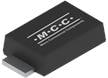
Micro Commercial Components (MCC) 40V to 200V Schottky Barrier Rectifiers
AEC-Q101 qualified, high-efficiency rectifiers in a compact DO-221AC package.